Chrome Steel Flanges
Chrome-moly flanges in ASTM A182 F1, F5, F9, F11, F12, F21, F22 and F91. For service that is hot, full of hydrogen, full of sulfur, and usually all three.
Start here
Chromium for heat, not for rust
Chrome steel in a flange context means chrome-moly: low alloy steel with chromium and molybdenum deliberately added. The chromium runs from around half a percent in F2 up to nine percent in F9 and F91. The molybdenum runs from about half a percent to one percent.
Neither element is there for corrosion resistance at ambient temperature. Chrome-moly rusts in the yard like any carbon steel flange, and it needs the same coating and storage care. What the alloying buys is performance at temperature: creep strength that holds up where carbon steel sags, resistance to high temperature hydrogen attack, and resistance to sulfidation.
That is why these grades live in refinery hydroprocessing, catalytic reforming, power boiler and main steam piping. Places where the metal spends decades hot.
Texas Flange has machined chrome-moly flanges since 1986, and the harder part of this work has always been the chemistry restrictions and the heat treatment, not the turning.
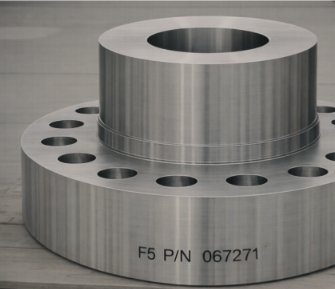
Three things it is not
Clearing up the name
"Chrome" on a flange enquiry gets used for three unrelated things, and the wrong reading sends the order to the wrong shop.
| If you mean | You want | Note |
|---|---|---|
| Low alloy steel for hot service | Chrome-moly, this site | A182 F1 through F91. Up to 9% Cr. Not corrosion resistant at ambient |
| Corrosion resistance at ambient | Stainless steel | Needs roughly 10.5% Cr minimum to passivate. See stainless flanges |
| A bright plated finish | Chrome plating on another base metal | A surface treatment, not an alloy. Usually decorative or hard chrome |
The 10.5 percent line is the important one. Stainless works because enough chromium forms a self-repairing passive oxide film. Chrome-moly stops at 9 percent, below that threshold, so it never passivates. People who assume an F9 flange will behave like a stainless one in wet service are disappointed quickly.
Materials
The grades we flange
All forging grades under ASTM A182, which is the specification for forged or rolled alloy and stainless steel pipe flanges, forged fittings, and valves and parts for high temperature service. Plate work runs to different specifications.
| Grade | Nominal | Classes | Where it belongs |
|---|---|---|---|
F1 | C-1/2Mo | Single | Moderate temperature. No meaningful chromium. Not recommended for new hydrogen service |
F2 | 1/2Cr-1/2Mo | Single | Light duty elevated temperature. Uncommon now |
F12 | 1Cr-1/2Mo | Class 1, 2 | Moderate elevated temperature, steam and process |
F11 | 1-1/4Cr-1/2Mo | Class 1, 2, 3 | A workhorse. Refinery process, hydrogen service, steam piping |
F21 | 3Cr-1Mo | Single | Between F11 and F22. Less common in North America |
F22 | 2-1/4Cr-1Mo | Class 1, 3 | The other workhorse. Hydroprocessing, heavy wall, higher temperature |
F5 / F5a | 5Cr-1/2Mo | Single | Sulfidation resistance. Crude and vacuum units, hot oil |
F9 | 9Cr-1Mo | Single | Higher sulfidation resistance and temperature capability |
F91 | 9Cr-1Mo-V, Grade 91 | Single | Highest creep strength in the family. Power plant main steam and reheat. Least tolerant of heat treatment error |
Class is not pressure class. On F11, F12 and F22 the class number describes the heat treatment condition and strength level of the forging. An F22 Class 3 forging machined into an ASME Class 300 flange is normal. Both numbers have to be on the order, and leaving the forging class off is a common cause of the wrong material arriving.
Full detail, including chromium ranges and the class strength levels, on the chrome-moly grades page.
Service
Three damage mechanisms decide the grade
Chrome-moly selection is almost never about pressure. It is about which of these three is going to attack the metal, and the answer is usually more than one.
Creep
Above roughly 800 degrees F, steel deforms slowly and permanently under load that it would carry indefinitely when cold. Chromium and molybdenum, and in Grade 91 vanadium and niobium, raise the temperature at which that becomes tolerable.
In this range the design code and the creep allowables govern, not the flange rating table.
High temperature hydrogen attack
Atomic hydrogen diffuses into the steel and reacts with carbides to form methane at grain boundaries. The result is internal fissuring and decarburization, and it is irreversible.
The safe envelope comes from the API 941 Nelson curves, plotting temperature against hydrogen partial pressure. More Cr and Mo buys more envelope.
Sulfidation
Sulfur compounds in hot hydrocarbon streams convert the surface to iron sulfide and thin the wall steadily. Chromium is the element that slows it, which is the whole reason 5Cr and 9Cr exist in refinery service.
Rates are estimated from the modified McConomy curves, or the Couper-Gorman curves where hydrogen is present.
There is a fourth mechanism that is not corrosion at all but is just as important on heavy wall hydroprocessing equipment: temper embrittlement, the slow loss of toughness in 2.25Cr-1Mo after years in the 650 to 1000 degree F range. It is controlled by restricting tramp elements rather than by choosing a different grade.
Fabrication
Chrome-moly is air hardening, and that changes everything
This is the practical difference between buying a carbon steel flange and buying a chrome-moly one, and it is where most chrome-moly problems originate.
Chrome-moly transforms to hard, brittle martensite on cooling from welding temperature, in still air, with no quench required. In the heat affected zone next to a weld that produces a narrow band of hard material sitting right beside a joint that also contains dissolved hydrogen from the welding process. Hard metal plus hydrogen plus residual stress is the recipe for delayed cracking, and delayed means days, not seconds.
The controls are not optional and they are not proprietary:
- Preheat, to slow the cooling rate through the transformation range and to drive off moisture. Typically a few hundred degrees F, rising with chromium content and section thickness.
- Interpass temperature control, maintained throughout, not established once and forgotten.
- Low hydrogen consumables, properly stored and dried. Damp electrodes put the hydrogen in deliberately.
- Post weld heat treatment, to temper the martensite back to something tough and to relieve residual stress. The design code sets the temperature and hold time by grade and thickness.
- Hardness verification after PWHT, because that is the measurement that proves the heat treatment did what was intended.
A skipped PWHT passes hydrotest. That is what makes it dangerous. The joint holds pressure on day one and cracks in service months later. Nothing in a pressure test detects an untempered heat affected zone.
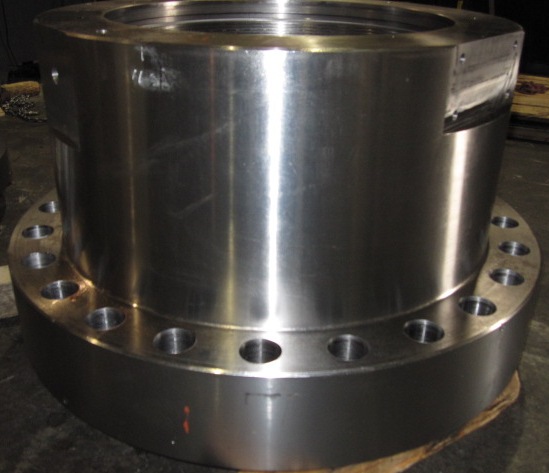
Grade 91 deserves its own warning
F91 has the best creep strength in the family and the narrowest processing window. Its properties come from a specific normalize and temper condition, and a PWHT that strays above the lower critical temperature re-austenitizes the material and destroys them. Recovery then means a full re-normalize, not another temper. Nickel and manganese are restricted precisely because they lower that critical temperature.
Product range
What we make in chrome-moly
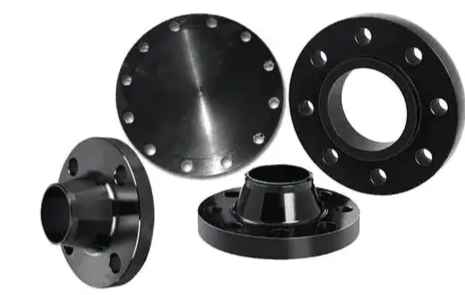
Flange types
- Weld neck, the dominant type on this service
- Slip-on, where the specification permits it
- Blind, and blind with ring joint groove
- Threaded and socket weld for small bore
- Lap joint with backing ring
- Long weld necks and special body connectors
- Studding outlets, also called pad flanges
- Reducing and off-pattern flanges to print
Patterns and classes
- ASME B16.5, NPS 1/2 through 24
- ASME B16.47 Series A and Series B, NPS 26 and up
- Classes 150 through 2500, plus API 5K through 20K
- Raised face, flat face and ring type joint facings
- Custom drilling and off-standard patterns to 203 inches
Certification and control
Material test reports
On every grade, with chemistry, mechanical properties and heat number traceability marked on the part.
Restricted chemistry
J-factor and X-bar controlled material for hydroprocessing, with step cooling results where the specification requires them.
Heat treatment condition
Certified to the class required, normalized and tempered or quenched and tempered, with the actual condition on the report.
Hardness
Held and reported, including sour service limits per NACE MR0175 and ISO 15156 where they apply.
Impact testing
Charpy testing at specified temperature where the code or the owner requires it.
Third party witness
Inspection and witness arranged where the project calls for it. Tell us at quote stage.
Quoting
What to put on the RFQ
Chrome-moly line items carry more information than carbon steel ones, and the extra items are the ones that get left off. Material that is dimensionally perfect and fails the chemistry restriction is no use to anybody.
- Nominal size and pressure class, or the drawing if it is off-pattern.
- Grade and forging class. A182 F22 Class 3, not just "F22".
- Flange type and facing, including the ring number on ring joint work.
- Bore or schedule on weld neck and slip-on, so the hub matches the pipe.
- Design pressure and temperature, and whether the service is in the creep range.
- Hydrogen partial pressure, if there is hydrogen. This is what the Nelson curve is read against, and a grade cannot be confirmed without it.
- Any restricted chemistry requirement. J-factor limit, X-bar limit, step cooling, and the specification imposing them.
- Hardness limits, and whether NACE MR0175 or ISO 15156 applies.
- Impact testing requirement and test temperature.
- Certification, MTRs, specification revision, third party witness, and any domestic origin requirement.
Send the service, not just the grade. If you tell us the temperature, the hydrogen partial pressure and the sulfur environment, we can confirm the grade is right before you buy it. Plenty of chrome-moly gets ordered one grade below what the Nelson curve actually allows.
Common questions
Is chrome steel the same as stainless steel?
No. Stainless relies on a passive chromium oxide film, and that needs roughly 10.5 percent chromium or more to form. The chrome-moly grades top out at about 9 percent, so they do not passivate and they rust like carbon steel. Chromium is in them for creep strength, hydrogen resistance and sulfidation resistance at temperature, not for corrosion resistance at ambient.
Does a chrome-moly flange have different dimensions from a carbon steel one?
No. An F22 Class 300 weld neck is dimensionally identical to an A105 Class 300 weld neck. The geometry comes from ASME B16.5 or B16.47 regardless of grade. What changes is the pressure-temperature rating at elevated temperature, and the fabrication requirements.
What does Class 1, 2 or 3 mean on an F11 or F22 forging?
It is the heat treatment condition and strength level, not the pressure class. F11 comes in Class 1, 2 and 3 and F22 in Class 1 and 3, each with different tensile and yield requirements. So an F22 Class 3 forging inside an ASME Class 300 flange is perfectly normal and not a contradiction. Both numbers belong on the order.
Do chrome-moly flanges always need post weld heat treatment?
Effectively yes for the grades above F1, and the design code sets the requirement by grade and thickness. Chrome-moly is air hardening, so welding leaves hard brittle martensite in the heat affected zone. Preheat controls the cooling rate and PWHT tempers what forms. Skipping it produces a joint that can pass hydrotest and crack later.
Which grade do I need for hydrogen service?
That comes off the API 941 Nelson curves, which plot safe operating limits against temperature and hydrogen partial pressure. More chromium and molybdenum buys more envelope. 1.25Cr-0.5Mo and 2.25Cr-1Mo carry most refinery hydroprocessing. Note that API 941 no longer recommends C-0.5Mo for new hydrogen construction after field experience showed attack below the historic curve.
Why do hydroprocessing specifications restrict silicon and phosphorus?
Temper embrittlement. Exposure in the roughly 650 to 1000 degree F range over years causes 2.25Cr-1Mo to lose toughness, and tramp elements drive it. Specifications limit the Watanabe J-factor on base metal and the X-bar on weld metal, and often require a step cooling test to demonstrate resistance. Ordinary A182 F22 to the bare specification does not satisfy those restrictions.
Chrome-moly flanges, quoted properly
Texas Flange has supplied industrial pipe flanges out of Houston since 1986, including the restricted-chemistry and heat treated work that most flange houses would rather not quote.
Send the print, or send the size, class and grade. Texas Flange quotes quickly.
Request a QuoteOr call 281-484-8325 and ask for the chrome steel flanges desk.