Chrome-Moly Grades
A working reference for the ASTM A182 chrome-moly forging grades, what the class numbers mean, and which grade belongs where.
These grades all come under ASTM A182, the specification for forged or rolled alloy and stainless steel pipe flanges, forged fittings, and valves and parts for high temperature service. They differ in chromium content, which is the variable that sets nearly all of their behaviour at temperature.
Composition
| Grade | Nominal | Chromium | Molybdenum | Other |
|---|---|---|---|---|
F1 | C-1/2Mo | Not specified | ~0.44 to 0.65 | Carbon-moly. No chromium to speak of |
F2 | 1/2Cr-1/2Mo | ~0.50 to 0.81 | ~0.44 to 0.65 | |
F12 | 1Cr-1/2Mo | ~0.80 to 1.25 | ~0.44 to 0.65 | Class 1 and 2 |
F11 | 1-1/4Cr-1/2Mo | ~1.00 to 1.50 | ~0.44 to 0.65 | Class 1, 2 and 3 |
F21 | 3Cr-1Mo | ~2.65 to 3.35 | ~0.80 to 1.06 | |
F22 | 2-1/4Cr-1Mo | ~2.00 to 2.50 | ~0.87 to 1.13 | Class 1 and 3 |
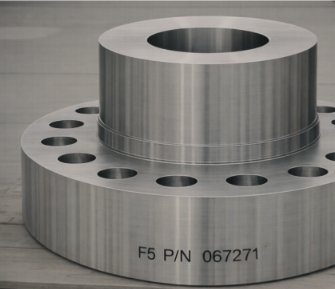
F5 | 5Cr-1/2Mo | ~4.0 to 6.0 | ~0.44 to 0.65 | F5a is a higher carbon variant |
F9 | 9Cr-1Mo | ~8.0 to 10.0 | ~0.90 to 1.10 | |
F91 | 9Cr-1Mo-V | ~8.0 to 9.5 | ~0.85 to 1.05 | V, Nb and controlled N. Ni plus Mn restricted |
The class system, and why it confuses people
On F11, F12 and F22 the grade designation is followed by a class number. That class is the heat treatment condition and strength level of the forging. It has nothing to do with the ASME pressure class of the flange.
"A182 F22 Class 3 weld neck, ASME Class 300" is a normal, correct description. Two different meanings of the word class in one line item. Material class first, pressure class second. Leaving the material class off is one of the most common reasons the wrong forging arrives.
Higher class means higher tensile and yield requirements, achieved through different heat treatment of the same chemistry. That gives a higher allowable stress in design, which can let you use a thinner section. It also generally brings tighter hardness control and less ductility, so it is a design decision rather than an upgrade.
The class has to be consistent with what the design calculation assumed. Substituting Class 1 where the calculation used Class 3 allowables is a real problem, not a paperwork one.
Choosing by service
| Service | Typical grade | Why |
|---|---|---|
| Moderate temperature steam and process, no hydrogen | F1, F12 | Cheapest step up from carbon steel for creep |
| Refinery process, moderate hydrogen partial pressure | F11 | The economical hydrogen service grade |
| Hydroprocessing, higher temperature and hydrogen | F22 | More Nelson curve envelope, heavy wall capability |
| Hot crude and vacuum service with sulfur | F5 | Chromium for sulfidation resistance |
| Higher temperature sulfidation | F9 | More chromium again |
| Power plant main steam and hot reheat | F91 | Creep strength, which allows thinner walls and faster cycling |
| Ambient corrosion resistance | None of these. Use stainless | Chrome-moly does not passivate below about 10.5% Cr |
What each increment of chromium buys
Chromium is doing three jobs at once as you move up the range, and they improve together:
- Creep strength, through solid solution strengthening and stable carbides, so the metal resists slow deformation at temperature.
- Hydrogen attack resistance, because chromium forms stable carbides that atomic hydrogen cannot easily convert to methane. This moves the API 941 Nelson curve up.
- Sulfidation resistance, because chromium-rich scales are far more protective than iron sulfide.
What it does not buy is aqueous corrosion resistance. Below roughly 10.5 percent there is not enough chromium to form a passive film, so all of these grades rust. They need the same coating, preservation and storage discipline as carbon steel, and a chrome-moly flange left uncoated through a wet winter looks exactly as bad as an A105 one.
Related specifications
| Specification | Product form |
|---|---|
ASTM A182 | Forged flanges, fittings and valve parts for high temperature service |
ASTM A387 | Chrome-moly pressure vessel plate, for plate and ring flanges |
ASTM A335 | Seamless ferritic alloy steel pipe, the P grades that mate to these flanges |
ASTM A234 | Wrought alloy steel butt welding fittings, the WP grades |
ASTM A217 | Chrome-moly castings for pressure service |
ASTM A193 / A194 | Bolting for high temperature service, B7, B16 and matching nuts |
The grade names run in parallel across these specifications. F22 forging, P22 pipe, WP22 fitting and Grade 22 plate are the same nominal alloy in different product forms. Getting the specification right for the form matters, because the mechanical requirements and heat treatment differ.
Beyond chrome-moly
Texas Flange carries the full industrial materials list. Carbon steel in A105, A350 LF2 and LF3, A694 and SA-516-70. Stainless in F304 and F316 with the dual, H and L variants, plus F309, F310, F317L, F321, F347 and Alloy 20. Duplex in F51 and F53. Nickel alloys including Hastelloy, Inconel, Incoloy and Monel. Plus aluminum, copper alloys and titanium.
See the Texas Flange catalog for the full range.
Common questions
What is the difference between F11 Class 1, 2 and 3?
Heat treatment condition and the resulting strength level. Class 1 is the lowest strength and the most ductile, Class 3 the highest strength. Same chemistry, different tensile and yield requirements, achieved through different heat treatment. Higher class means higher allowable stress and usually tighter hardness control, so it is not automatically the better buy.
Is F22 always better than F11?
It has more chromium, so it carries more temperature, more hydrogen partial pressure and more sulfidation resistance, and it costs more. If the Nelson curve and the temperature allow F11, F11 is the correct answer, not a compromise. Buying F22 where F11 suffices is money spent for nothing, and on heavy wall work it also brings temper embrittlement restrictions you would not otherwise have to manage.
Why is F1 no longer recommended for hydrogen service?
Field experience showed C-0.5Mo steels suffering high temperature hydrogen attack inside what the historic API 941 curve treated as safe. The guidance changed as a result, and C-0.5Mo is no longer recommended for new hydrogen construction. Existing equipment is assessed case by case. If your service has hydrogen, start at 1.25Cr-0.5Mo.
What is the difference between F9 and F91?
Both are nominally 9 percent chromium and 1 percent molybdenum. F91 adds vanadium, niobium and controlled nitrogen, which precipitate fine carbonitrides and give it far higher creep strength. That extra strength comes from a specific normalize and temper condition, so F91 is much less tolerant of heat treatment error than F9.
Do you supply F92 or other advanced grades?
Grade 92, the 9Cr-2W variant, and other advanced creep-strength-enhanced ferritic grades come up on newer high efficiency power plant work. Send the requirement and the specification. Availability in flange sizes is narrower than for F91 and lead time reflects it.
Chrome-moly flanges to grade and class
Give us the grade, the forging class and the service conditions. If the grade is below what the service needs, we will say so.
Send the print, or send the size, class and grade. Texas Flange quotes quickly.
Request a QuoteOr call 281-484-8325 and ask for the chrome steel flanges desk.